

Adult Homework
To read, watch, play, wonder

Happy Thursday! This bonus letter is free because it’s in partnership with Book of the Month. Inside: a year-to-date reading recap from yours truly, interviews with the director of an art crime film and the creator of a show about why “men don’t f*cking like her,” and much more. Enjoy!


READING / WATCHING
Book of the Month’s “Nobody Reads Anymore” campaign asserts that all the claims about our generation’s illiteracy are wrong. People are reading; in fact, Americans are buying more fiction now than ever before. I can attest — I love peering over shoulders on the subway, in the park, at coffee shops (like Rob Pat in The Drama) and scanning for titles. Earlier this year, everyone had a copy of Wuthering Heights, even the tech boys in black ergonomic backpacks. You can read the manifesto here.
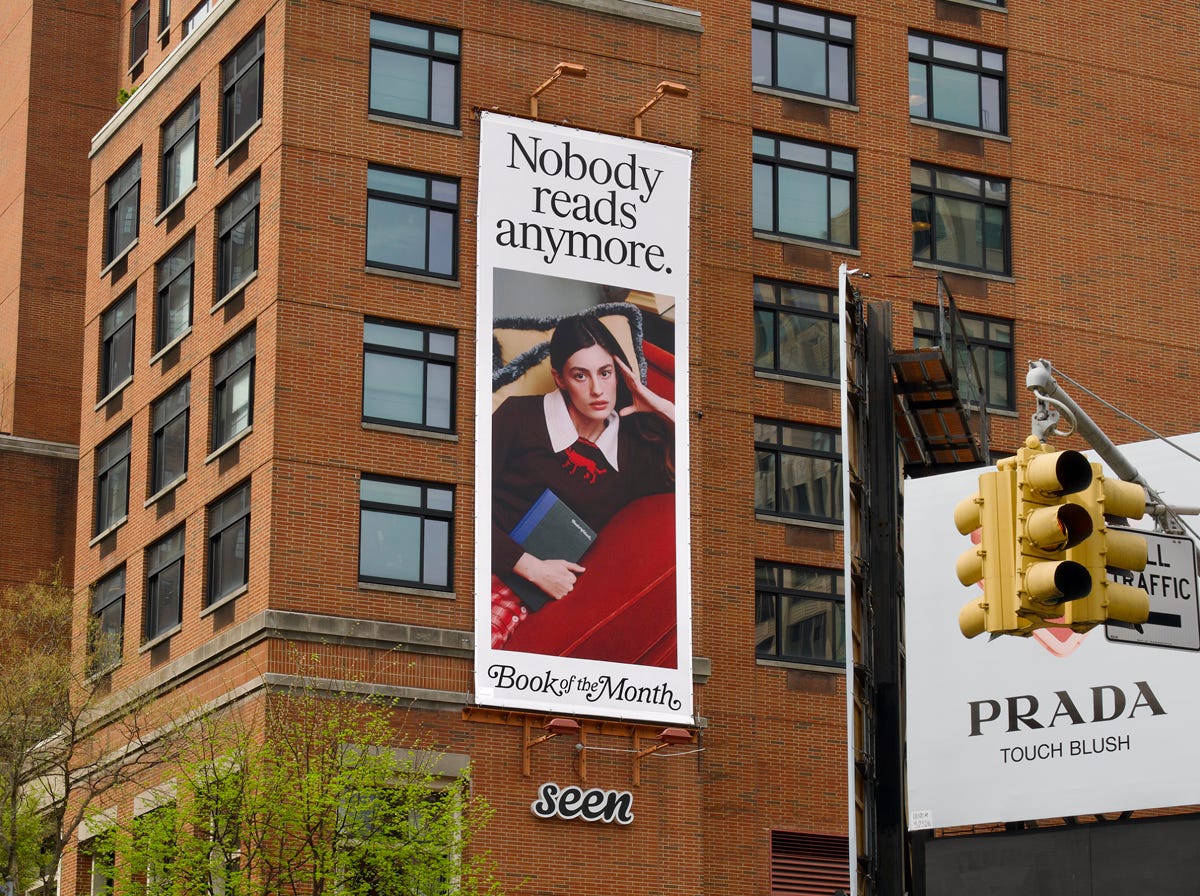
Once I walked by Diana Silvers in front of Culture froyo… I’ve read at least 14 books this year. I could be forgetting some. Highlights include Famesick by Lena Dunham, Intermezzo by Sally Rooney, The Wilderness by Angela Flournoy, The House of Mirth by Edith Wharton, All Fours by Miranda July, Less by Andrew Sean Greer. I’m currently reading Transit by Rachel Cusk, Lovers XXX by Allie Rowbottom, The Age of Innocence by Edith Wharton, and Stoner by John Williams.
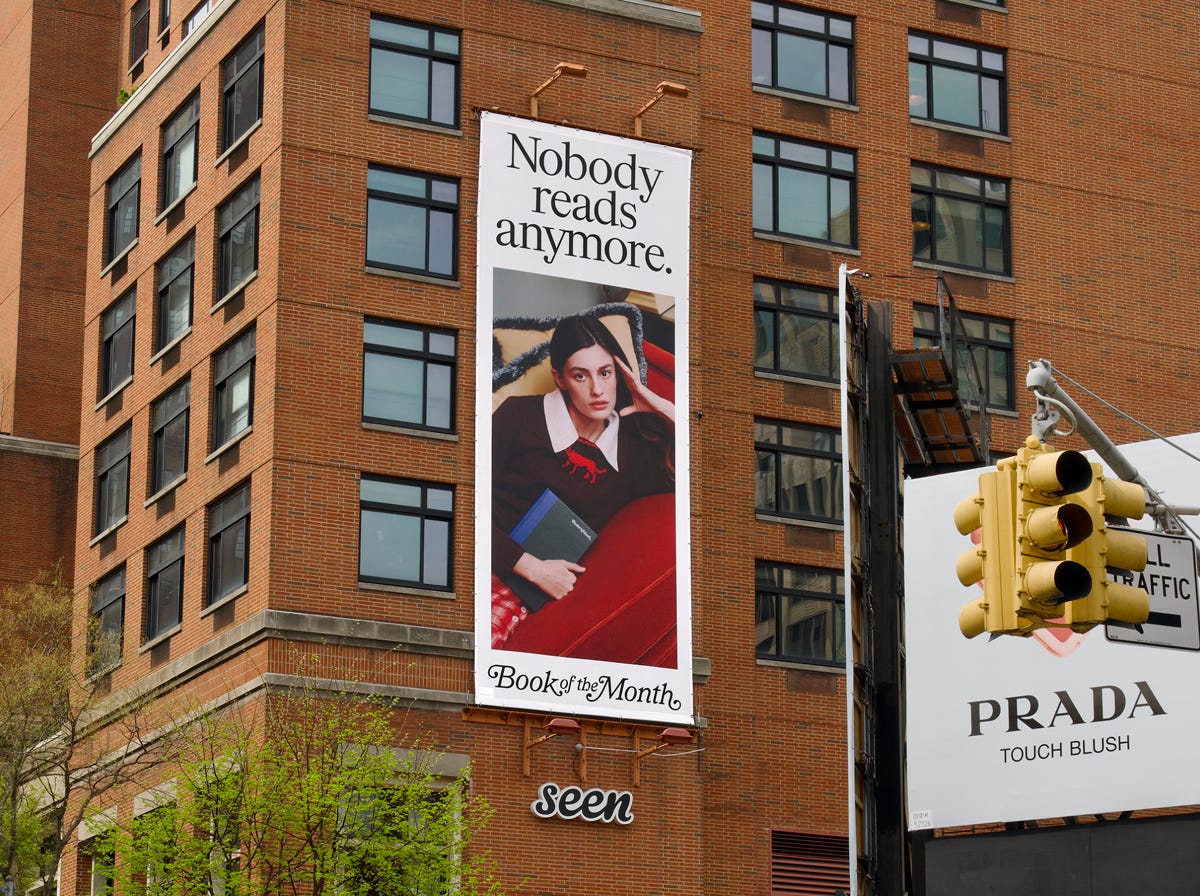
some book notes:
All Fours got me out of a fiction rut. You know the feeling of reading or watching something popular, and thinking, I cannot believe everyone else also experienced this? Moms in book clubs nationwide also entered this fever dream of a book, with sweaty, possessed dancing in refurbished motel rooms, memories of pain and grief, descriptions of bodies that are both fleshy and hollow. I can’t really picture any of the characters in this book, but I know what they feel like, and how they move.
Two of the books I’ve read explicitly mentioned Covid and used it as a plot device. It was strange. I think the pandemic should be omitted from the arts.
I met a college-aged couple at a cafe in San Juan. The guy asked me what book I was reading, and exclaimed “STONER!” when I flipped the cover to face him. He read it three years ago, but still remembered it in alarming specificity. “I love this one line on page 12,” he said, “when Stoner’s still living at the farm.”
Nearly every character in Stoner is described as “thin,” “slender,” “pale,” or “delicate.” The book follow a professor at the University of Missouri; it’s as if possessing any excess flesh or fat would detract from one’s ability to be rigorous, tireless, and exacting in the world of ideas. I noticed the same trope of the emaciated intellectual in R.F. Kuang’s Katabasis, a novel about doctorate candidates at Cambridge.
If you have any great recommendations, preferably ones that take me outside of my genre comfort zone (see list above), let me know in the comments.
emerging out of the book stack…
I’m a sucker for Substack self-help, and Model Actress wrote a very good guide to being happy and well. My favorite tip was the second one: “pay attention to your fabrics, wear cotton and linen and free flowing comfortable clothes to cultivate calmness. i promise it works. the clothes on your body can be overstimulating you.”
I love when Haley Nahman’s Sunday essay hits my inbox at 6am. Sometimes I’m actually awake to read it, other times I save it for a subway ride. Early on in my Substack “career” one of my friends from school said Ad Hoc reminded her of Maby Baby. I was very flattered! Haley does a generous, thorough job of investigating the everyday. Recent standouts include this letter on Disneyland (I coincidentally wrote my big high school research paper on Walt Disney and his dream of a utopic amusement park) and this one on Botox.
I was watching Girls last night, where a commercial editor at GQ humble-bragged about publishing in n+1. Some things never change, I guess. “Creature of the Late Afternoon” by E. Tammy Kim in n+1 is an essay about midlife, childlessness, and family. I will read and appreciate anything about a Korean woman’s relationship with her mother.
On my way to work, I listened to a podcast from Articles Of Interest that explains why taxes are the reason Elon Musk and Mark Zuckerberg dress so plainly. Elon Musk pays himself $100k per year, the starting salary of an investment banker straight out of college, to avoid egregious income taxes. To fund multi-million-dollar homes and planes and weddings, instead of selling stock and facing capital gains tax, the ultra-rich borrow against their ever-growing positions to lenders who are happy to make a percentage off of the likes of Larry Ellison. They wear t-shirts and jeans to pretend they are just like us, when really they are aliens situated in unfathomable versions of reality.
The Taylor Swift interview with The New York Times made me like her again. Sigh… Every time I get fed up with her millennial cringe and undiluted egoism, she gives a long-form interview and awakens a twelve-year-old version of Arden that cried in Whole Foods after I saw Taylor had followed me on Tumblr. She talked about bridges (the section after the second chorus, AKA the best part of any 2008-2012 Taylor Swift song) as sections that capture the essence of the song, carve out space for a rant, or complete the narrative.
< interviewland >
I got to see an advance screening of Forge, which premiered at SXSW 2025, and chat with the director Jing Ai Ng about it. The thriller follows Coco and Raymond, a brother-and-sister duo running an art forgery scheme in Miami.
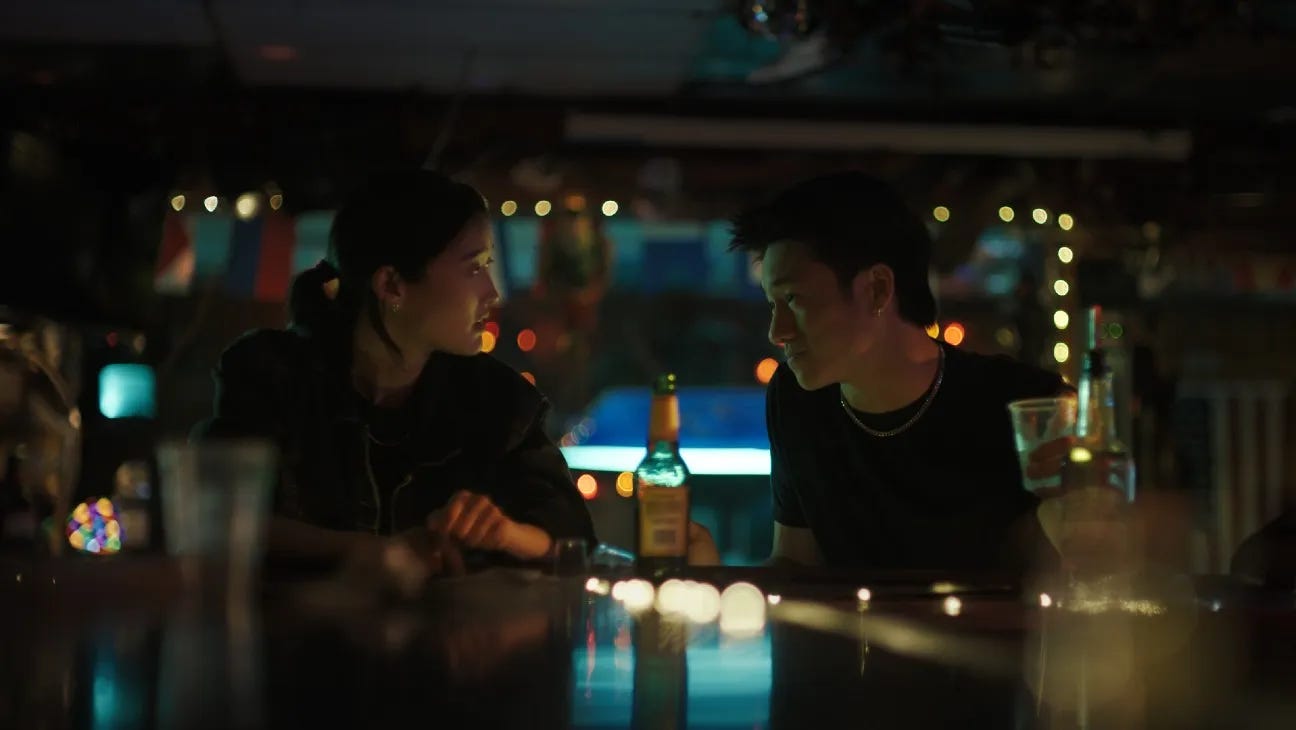
Arden: I’m curious about why the story is set in Miami, as opposed to another art hub like New York or LA?
Jing: I’m from Miami, and I’m very familiar with the city and how it’s kind of changed as Art Basel has crept in. So it felt natural to be able to set it in, for example, the restaurant my parents and I ate in every week, which is the same restaurant in the movie.
Arden: How familiar were you with the art forgery world before you started writing?
Jing: I had a family member commit white collar crime. I found out through Wikipedia when I was fourteen. It was a huge case, and my family had never mentioned it before, in true Asian fashion. One moment I had this perfect Asian family, and the next I did not, and it completely changed my view of human nature. Why do these people need more?
But also, I love art and I love art forgery, specifically because forgers are creating masterpieces under the guide of someone else. The most recent art forgery case in New York was $80m worth of art. A Chinese guy forged all of that.
Arden: Why did you choose the sibling dynamic to be the relationship at the core of the film?
Jing: It’s personal. I have two siblings, an older sister and an older brother. My older sister was kind of the golden child, and me and my brother got into trouble. I think it's important to show that even within the family, people are different, and Asian Americans are not a monolith. Not everyone falls under this model minority myth, and family members have different issues and personalities. What does it mean to grow up so close to someone, and then at some point, you have to live separate lives? That kind of main is interesting to me.
Arden: What has your emotional response been to people seeing Forge for the first time?
Jing: What's important about making Forge was that it had the right to exist. When I started writing it, I could not think of another Asian American movie like it, which was scary. I didn’t have a reference.
When I screen Forge, I'm just proud that it exists. Because maybe later on, when someone wants to write a film with an Asian American female lead, they can use it as a reference. And maybe they're gonna hate it… but at least they can look.
Betty Kubovy-Weiss released a teaser for her new show, He Likes Me Not, where she “investigates why the men in her life don’t f—ing like her.” Betty explained the concept to me at a birthday party in December, and I thought about how terrifying and cathartic it would be to perform the exercise myself. The show reminds me of when Rachel Cohn Are You My Boyfriend? interviewed a guy who ended things after two dates. It’s a fascinating read… “The real issue, I think, was that despite finding each other interesting and attractive, we were somehow speaking different languages.” Episode one of Betty’s show premieres today. I asked her a couple questions:
Arden: Did the answers you received match your assumptions of why xyz situation didn’t work out?
Betty: Yes and no. What I came to find out (and what became sort of the thesis of the show) is that you can’t really pin down one reason why a relationship didn’t work out. My character in the show thinks she can identify “the reason” and change herself to change the ending. And not even in a “love yourself! You’re perfect the way you are!” way. People are just complicated and often can’t even tell you themselves why they did or didn’t like you.
Arden: What do you think makes two people compatible?
Betty: I honestly have no idea what makes people compatible— or rather, what makes them compatible in specific ways and not others. The guys I interviewed were often some of my closest friends. What makes people compatible to be friends, to want to spend time with each other? In some cases even to sleep with each other, but not be in a relationship? The cynic in me says beauty standards, social pressures, or feeling like you already have what you need from someone. Part of the impetus for the series was that I have spent so much of my life wondering what kept me from that leap from friends to something more. But maybe that way of thinking kept me from realizing just how compatible I was with some of these people, but maybe not in the most obvious, romantic way.
HOMEWORK
Go outside and sit in a park for at least an hour. Listen to the wind and the traffic and the chatter and the music (I’m sure there will be music). Translate the visuals in front of you into strings of words and collect them in a notebook: flip flops peeking out of long black jeans, ice cream splash, the man with the wand is making rainbow-edged bubbles. You can use these snippets later. Or draw a picture.
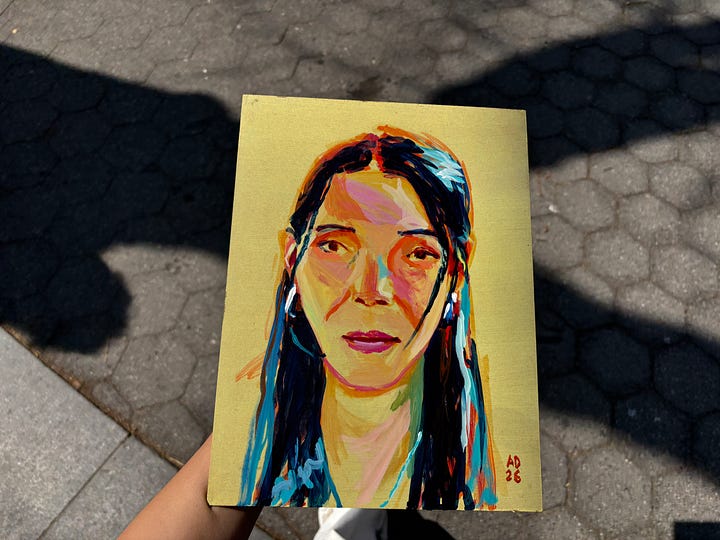
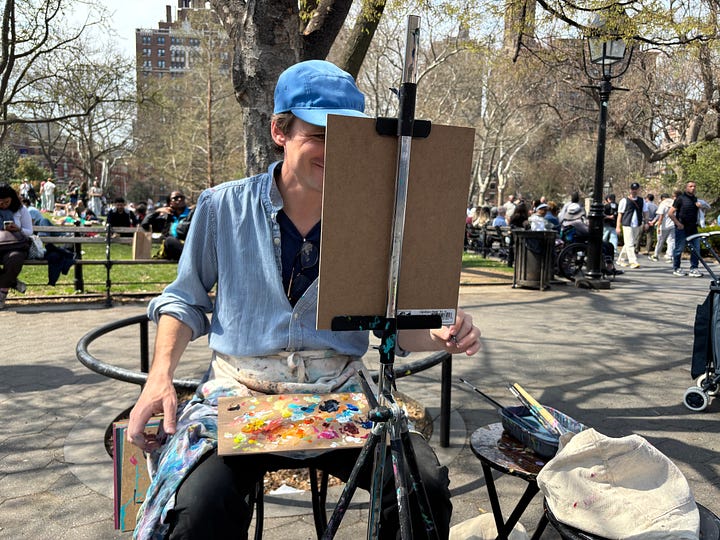
The last time I sat in Washington Square Park with no stimulation, a painter named Adam Dressner approached me and asked if I wanted to sit for a free portrait. We ended up talking for an hour and a half. He was a law student at Yale a few years before I arrived as an undergraduate. He quit his job in corporate law to become an artist.
Cook a meal in accordance with the season. Peas, ramps, asparagus, strawberries, rhubarb, artichokes, cherries, and radishes are especially delicious right now. Eat at a table, without your phone, laptop, or TV in front of you. Take a deep breath. Put your fork down in between bites.
If you live in New York, I recommend a trip to the Whitney Biennial. The museum is free if you’re under 25 (I still have two more years).
When you see a long line of people on the sidewalk, instead of rolling your eyes and taking a picture (which I sometimes do), ask them what they’re waiting for (which I usually do).
Give someone a specific compliment, like your hair looks so healthy and shiny, or the way you ask questions makes me want to be a more thoughtful person.
What percentage of people you’ve met do you like? If you asked me a year ago, the number would have been much lower than it is today. I think I was judging people as a twisted method of self protection. Wherever you are on the scale, try to increase it by 10-20%. You will likely end up with more friends, more experience, or at least having a more pleasant time in social settings.


I hope you liked this letter. Let me know what you think about any / all of it in the comments.
I think you would really love ‘Lives of the Saints’ by Nancy Lemann - it was a perfect spring-summer transitional read. feels quite refreshing for the 80s?
I loved this letter--especially your advice to try to like more people you meet!!